Custom Search


Inside AdSense: +1: Now making Display ads more relevant: Earlier today we announced several exciting new additions to Google+, including open signups. We’d like to announce one more addition fo...


Read Users' Comments ( 0 )

Palestinians will submit UN membership


Custom Search
19 September 2011 –
The President of the Palestinian Authority, Mahmoud Abbas, told Secretary-General Ban Ki-moon today that he intends to submit an application this Friday for Palestine to become a United Nations Member State.

During their meeting, which took place at UN Headquarters on the margins of the 66th session of the General Assembly, Mr. Ban informed Mr. Abbas of his intention to perform his duties under the UN Charter. Palestine currently has observer status at the UN.

According to the provisions of the Charter, the Secretary-General is tasked with verifying a letter requesting UN membership, following which he sends it to the Security Council and the General Assembly.

The application is considered by the Council, which decides whether or not to recommend admission to the 193-member Assembly, which has to adopt a resolution for the admission of any new Member State.

“The Secretary-General reiterated his support for the two-State solution and stressed his desire to ensure that the international community and the two parties can find a way forward for resuming negotiations within a legitimate and balanced framework,” Mr. Ban’s spokesperson, Martin Nesirky, told reporters.

The Secretary-General also discussed with Mr. Abbas the ongoing efforts in this regard by the diplomatic Quartet, comprising the European Union, Russia, the UN and the United States.

Israeli-Palestinian peace talks have been stalled since late September 2010 following Israel’s refusal to extend a 10-month freeze on settlement activity in the occupied Palestinian territory.

That decision prompted Mr. Abbas to withdraw from direct talks with Israeli Prime Minister Benjamin Netanyahu, which had only resumed a few weeks earlier after a two-year hiatus.

In a related development, the Special Adviser to the Secretary-General on Sport for Development and Peace, Wilfried Lemke, has just concluded a three-day visit to Israel and the occupied Palestinian territories.


“At a time when the eyes of the world are turned to the region once again and when the question of Palestinian statehood is highly prominent on the international agenda, the Special Adviser is determined to continue his work in mobilizing the power of sport to open up channels of dialogue and mutual understanding, and driving social development in the region,” stated a news release issued by Mr. Lemke’s office.


Read Users' Comments ( 0 )

Free Books Online

Our local index includes more than a million works in various formats that meet these criteria. (Over 40,000 are in our "curated collection", representing entries we've personally edited. The rest are in our "extended shelves", entries that are provided by other organizations and imported in bulk.) All of the books we list should be free for personal, noncommercial use. You can:


Read Users' Comments ( 0 )


Custom Search
SLAMABAD: As tension prevails between the United States and Pakistan, Prime Minister Syed Yousaf Raza Gilani summoned Foreign Minister Hina Rabbani Khar back to Islamabad on Sunday for the All Parties Conference (APC).

Khar’s presence is said to be vital during the APC as she was one of the few members of the civilian leadership to have been directly approached by US officials regarding allegations of Pakistan running a proxy war in Afghanistan via the Haqqani network.

According to the Pakistan embassy in the United States, Khar will be cutting her trip short and likely flying back to Pakistan tonight. She will meet both Gilani and President Zardari on arrival, say sources.

Gilani on Sunday contacted leaders of various political parties to develop a consensus over the US allegations against Pakistani security institutions via the APC.

(Read more: Pakistan not responsible for security of US forces, says PM)

Sources said that the government has decided to take all the political parties on board before drafting a strategy over the allegations by the US that Pakistan was complicit with the Haqqani network responsible for last week’s attack on the US embassy and a Nato headquarters in Kabul.

Gilani contacted Pakistan Muslim League-Nawaz (PML-N) chief Mian Nawaz Sharif, Muttahida Qaumi Movement (MQM) chief Altaf Hussain and Awami National Party (ANP) chief Asfandayar Wali .


On Sunday, Pakistan’s military leadership also unanimously rejected the allegations leveled against Pakistani security institutions by the United States.

The six hour long emergency Corps Commanders meeting chaired by Chief of Army Staff General Ashfaq Pervez Kayani concluded in Rawalpindi on Sunday. Sources said no formal declaration of the meeting will be issued.

Chairman joint chiefs of staff committee (CJCSC) General Khalid Shamim Wynne expressed concern over the recent statements made by the US, and said that Pak-US relations need to be improved.


Read Users' Comments ( 0 )


Custom Search
LAMABAD: Interior Minister Rehman Malik said that the Haqqani network were created and trained by the United States Central Intelligence Agency (CIA).

Speaking to the media in Islamabad, Malik rejected US claims of the Haqqani network operating from Pakistan soil.

He maintained that the Haqqanis have no links with Pakistan and are operating from Afghanistan.

Malik’s statements run contrary to claims by the Haqqani’s, who recently warned Washington against any military adventure in the North Waziristan tribal agency.

Sirajuddin Haqqani said he’d look forward to a US ground attack in North Waziristan. “The United States will suffer more losses [in North Waziristan] than they did in Afghanistan,” he said.

As reported earlier, the top US military officer Admiral Mike Mullen had called the Haqqani network a “veritable arm” of Pakistan’s intelligence service and accused Pakistan of “exporting” violent extremism to Afghanistan.

“With ISI support, Haqqani operatives planned and conducted (September 11) truck bomb attack, as well as the assault on our embassy,” Mullen said.


The Interior Minister said no compromise will be made on Pakistan’s sovereignty as Pakistan suffered a loss of $68 billion in the fight against terrorism.

Malik also said that no one will be allowed to enter Pakistan without immigration clearance.


Read Users' Comments ( 0 )


Custom Search
ISLAMABAD: The Pakistan Army has decided not to reverse its decision to expel US military trainers and scale back the activities of the Central Intelligence Agency (CIA) operatives in the country despite Washington’s punitive move to withhold $800 million worth of assistance.
The decision was taken at a meeting of the corps commanders chaired by Army chief General Ashfaq Parvez Kayani on Tuesday to discuss the fallout of the US step, said a military official. “We are not going to reconsider some of the decisions we have taken with regards to the activities of CIA in Pakistan,” the official said on condition of anonymity.
The security establishment, which was irked by the unilateral US raid that killed al Qaeda chief Osama bin Laden in May, launched a crackdown against the ‘CIA network’ to limit its activities.
Meanwhile, Chairman Joint Chiefs of Staff General Khalid Shameem Wynne told a top visiting US commander that Pakistan would not accept conditional aid and regretted the lack of acknowledgement by Washington for Pakistan’s “sacrifices in the battle against militancy.”
General James N Mattis, Commander US Central Command (Centcom), was on an announced trip to Pakistan to discuss regional security in the wake of recent developments. However, there was no official word if the top US general met General Kayani.
It is believed that in recent months General Kayani has made deliberate efforts not to publicise his engagements with US officials after being perceived to be too close to the Americans in the wake of the Bin Laden debacle.
A statement issued by the ISPR after the corps commanders meeting appeared to play down the US decision to suspend military assistance. “The forum reiterated the resolve to fight the menace of terrorism in our own national interest using our own resources,” the statement read.


However, it did not reveal if thousands of Pakistani troops would be pulled out from the Pak-Afghan border region if relations with the US deteriorated.
The somewhat mild reaction was attributed to the fact that the military hopes to settle the issue of withholding of aid through dialogue with American authorities, said military sources.
However, sources say, the corps commanders expressed their concern over the US decision, noting that it would not help the anti-terrorism campaign and will also cast a negative impact on the Pak-US bilateral cooperation in the fight against terrorism.
The top brass was also irked by the many strings attached to the US assistance. “No country has done more than Pakistan to eliminate al Qaeda and its affiliate groups,” said a senior military official. “Yet we remain in the eye of the storm, which is unfair.”
The official added that military commanders assert that the US must keep in mind the sacrifices of the Pakistani armed forces before making such harsh decisions.
According to an ISPR spokesman, the army chief appreciated the conduct of the ongoing operations. Referring to Mohmand Agency, he instructed that all efforts must be utilised in coordination with the civil administration for safe repatriation of the IDPs.
He said that the aim of the operation in Kurram Agency was to clear the area of miscreants involved in terrorism, kidnapping, killing of locals and blocking of roads connecting lower and upper Kurram.

Custom Search


RAWALPINDI: Pakistan’s military leadership on Sunday unanimously rejected the allegations leveled against Pakistani security institutions by the United States.
The six hour long emergency Corps Commanders meeting chaired by Chief of Army Staff General Ashfaq Pervez Kayani concluded in Rawalpindi on Sunday. Sources said no formal declaration of the meeting will be issued.
Chairman joint chiefs of staff committee (CJCSC) General Khalid Shamim Wynne expressed concern over the recent statements made by the US, and said that Pak-US relations need to be improved.
Sources said the military top brass decided that every decision is to be taken in Pakistan’s interest and that attacks from Afghanistan on the Pak-Afghan border will not be tolerated in the future.
An emergency meeting of Corps Commanders was called by General Kayani in the wake of the prevailing security situation and tension in relations with the United States.
An Inter Services Public Relations (ISPR) statement said the meeting was being chaired by Kayani. Issues regarding national security are on top of the agenda.
All corps commanders and principle staff officers attended the meeting.
According to sources, recent allegations leveled by US military chief Mike Mullen that Pakistan has links with the Haqqani network will also be discussed.
The Pakistan Army has denied accusations by senior US officials that Pakistan’s intelligence service supports the Haqqani network, saying it is based in Afghanistan.
However, spokesman for the ISPR Major General Athar Abbas did acknowledge that the ISI had contacts with the Haqqanis.
He told CNN that any intelligence agency prefers keeping contacts with opposition groups and terrorist organizations for some sort of positive outcome.
He stressed that this does not mean the ISI supports or endorses the organization.


Abbas also added that Pakistan is not the only country which maintains contacts with the Haqqanis.
He also expressed his shock at Mullen’s assertion that Pakistan was complicit in recent attacks against the US Embassy in Kabul.
In an earlier statement, Kayani termed the comments by Mullen as ‘unfortunate’, and ‘not based on facts’.
In the first official reaction to the slew of public statements made by various levels of the US administration against the ISI and suspected links between the Haqqani network and the Pakistan establishment, Kayani said that he had held a constructive meeting with Admiral Mullen in Spain last week.
He termed the statements following that meeting as very disturbing.
On the question of contacts with Haqqani network, Kayani said that Admiral Mullen knows well which countries are in contact with the Haqqanis. Singling out Pakistan as the chief protagonist is neither fair nor productive, he said.
‘Self-defeating blame game’
Prime Minister Yousuf Raza Gilani on Saturday rejected US allegations linking Islamabad with the Haqqani terror network, saying the “blame game is self-defeating”.
Gilani said such accusations would only benefit the militants, and added that they showed US policy in Afghanistan was in “disarray”.
“We strongly reject assertions of complicity with the Haqqanis or of proxy war,” he said in a policy statement issued by his office amid a growing rift with the United States.
“Blame game is self-defeating… It will only benefit the enemies of peace. Only terrorists and militants will gain from any fissures and divisions.”
The White House demanded Friday that Pakistan “break any link they have” with the Haqqanis, the al Qaeda-linked Taliban faction blamed for the recent attack on the US embassy in Kabul.
A day earlier top US military officer Admiral Mike Mullen directly accused Pakistan’s intelligence service of supporting the network’s attack on the embassy and a truck bombing on a NATO outpost.


Read Users' Comments ( 0 )

History Of Pakistan


Custom Search
British Rule and Muslim League

The British ruled the Indian subcontinent for nearly 200 years-from 1756 to 1947. After the Indian Mutiny of 1857, the British government abolished the powers of the British East India Company, which had ruled the sub-continent on behalf of the British Crown, and took on direct powers of governance. Political reforms were initiated, allowing the formation of political parties. The Indian National Congress, representing the overwhelming majority of Hindus, was created in 1885. The Muslim League was formed in 1906 to represent and protect the position of the Muslim minority. When the British introduced constitutional reforms in 1909, the Muslims demanded and acquired separate electoral rolls. This guaranteed Muslims representation in the provincia l as well as national legislatures until the dawn of independence in 1947.The idea of a separate Muslim state in south Asia was raised in 1930 by the poet and philosopher Sir Muhammad Iqbal.

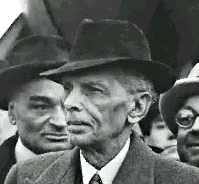
Quaid-e-Azam He suggested that the north-western provinces of British India and the native state of Jammu and Kashmir should be joined into such a state. The name "Pakistan", which came to be used to describe this grouping, is thought to have originated as a compound abbreviation made up of letters of the names of the provinces involved, as follows: Punjab, Afghania (North West Frontier Province), Kashmir, Indus-Sindh, and Balochistan. An alternative explanation says the name means "Land of the Pure". By the end of the 1930s, Muhammad Ali Jinnah, leader of the Muslim League and considered the founding father of Pakistan, had also decided that the only way to preserve Indian Muslims from Hindu domination was to establish a separate Muslim state.


Creation of Pakistan
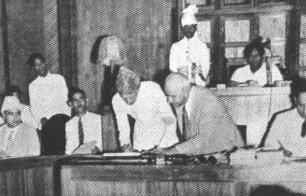
In 1940 the Muslim League formally endorsed the partitioning of British India and the creation of Pakistan as a separate Muslim state. During pre-independence talks in 1946, therefore, the British government found that the stand of the Muslim League on separation and that of the Congress on the territorial unity of India were irreconcilable. The British then decided on partition and on August 15, 1947, transferred power dividedly to India and Pakistan. The latter, however, came into existence in two parts: West Pakistan, as Pakistan stands today, and East Pakistan, now known as Bangladesh. The two were separated by 1,600 km (1,000 mi) of Indian territory

Problems of Partition
The division of the subcontinent caused tremendous dislocations of populations. Some 6 million Hindus and Sikhs moved from Pakistan into India, and about 8 million Muslims migrated from India to Pakistan.

The demographic shift was accompanied by considerable inter-ethnic violence, including massacres, that reinforced bitterness between the two countries. This bitterness was further intensified by disputes over the accession of the former native states of India to either country. Nearly all of these 562 widely scattered polities had joined either India or Pakistan; the princes of Hyderabad, Junagadh, and Kashmir, however, had chosen to join neither country. On August 15, 1947, these three states became technically independent, but when the Muslim ruler of Junagadh, with its predominantly Hindu population, joined Pakistan a month later, India annexed his territory. Hyderabad's Muslim prince, ruling over a mostly Hindu population, tried to postpone any decision indefinitely, but in September 1948 India also settled that issue by pre-emptive annexation. The Hindu ruler of Jammu and Kashmir, whose subjects were 85 per cent Muslim, decided to join India. Pakistan, however,

questioned his right to do so, and a war broke out between India and Pakistan. Although the UN subsequently resolved that a plebiscite be held under UN auspices to determine the future of Kashmir, India continued to occupy about two thirds of the state and refused to hold a plebiscite. This deadlock, which still persists, has intensified suspicion and antagonism between the two countries.


Read Users' Comments ( 0 )